
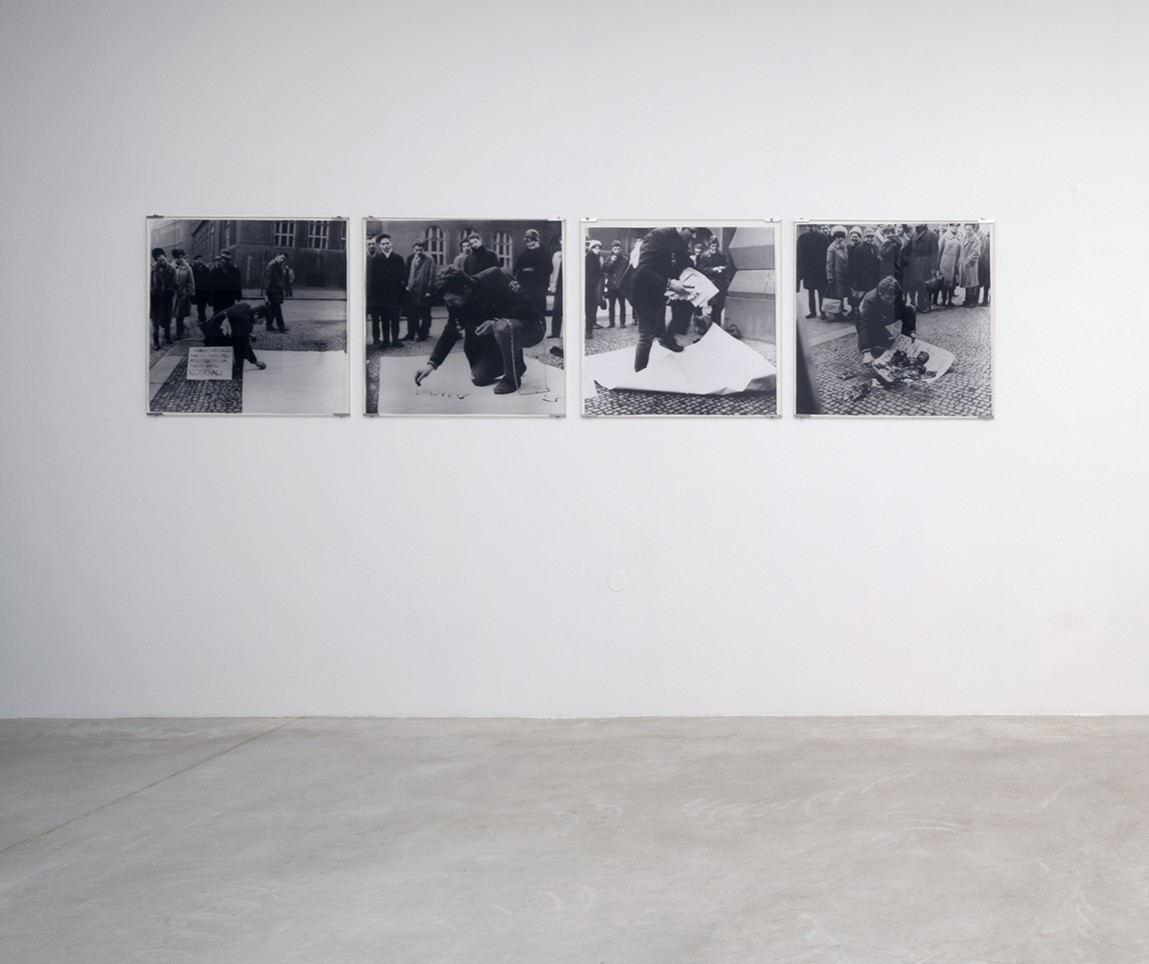
Milan Knížák, Demonstration for One, black and white photographs, 1964; photo: Dejan Habicht
We are saddened to announce the passing of Milan Knížák, one of the key figures of the Czech and Eastern European postwar avant-garde and an important figure in international contemporary art.
Born in Plzeň, Knížák began developing his practice of happenings and street actions while studying in Prague in the early 1960s. Between 1963 and 1971, together with the collective Aktual, he realized a series of participatory actions, including Demonstration for All the Senses and Demonstration for One. Through these works, as well as his experiments with music, samizdat, mail art, and performance, he explored the intersections between art and everyday life, testing the transformative potential of artistic practice within its social and political context.
Knížák joined the international Fluxus network in the mid-1960s and, from 1965, directed Fluxus East, the movement's Eastern European branch. In this capacity, he organized Fluxus events in Prague, Budapest, Poznań, and Vilnius, helping to establish connections among artists across the Iron Curtain. Between 1968 and 1970, he was active in the United States, where he realized numerous performances and actions, including Lying Ceremony (1967–1968) in New Jersey and Difficult Ceremony (1966–1969) in New York.
After returning to Europe, Knížák continued to expand his experimental practice across performance, sound art, experimental film, and other intermedia forms. From 1990 to 2015, he taught at the Academy of Fine Arts in Prague, serving as its Rector between 1990 and 1997. From 1999 to 2011, he was Director of the National Gallery Prague.
His works are held in the collections of numerous leading museums and institutions worldwide, including Museum of Modern Art (MoMA), New York; Centre Pompidou, Paris; National Gallery Prague; Kontakt Collection; and many others.
Knížák first exhibited at Moderna galerija in 1993 in the group exhibition Détente. In 1998, he participated in the landmark exhibition Body and the East with the work Becoming aware of a stone (1977). The Arteast 2000+ Collection includes his Demonstration for One (1964), one of his earliest participatory actions. Based on a simple yet radical gesture, the work stages a demonstration for a single participant, overturning the conventional logic of public protest and collective political action. Instead, it foregrounds the individual encounter and invites reflection on the relationship between the individual and the collective, questioning how communities are constituted. Its economy of means, wit, and subtle subversion exemplify the qualities that characterize Knížák's early artistic practice.
Milan Knížák played a pivotal role in the development of performance, happenings, intermedia art, and experimental artistic practice in Central and Eastern Europe. His work challenged conventional understandings of art and its social function, while contributing to the formation of international artistic networks that transcended political and ideological boundaries. His legacy continues to shape the history of postwar avant-garde art and its relevance today.
