



Lene Lekše’s work could be read as a sort of game theory, but unlike in its mathematical models, the goal of maximizing utility outcomes is here replaced but another, less easily definable objective. Like in the mathematical models of game theory, we can observe (or find ourselves in the role of) “players” and their choices or actions and interactions that reveal specific strategies, combinations, and tactics from which the rules of the game can be ultimately deduced. Regardless of what her given field is – sports grounds, city streets, intertextuality, or the landscape – Lekše presents us with elements in motion, leaving us to decipher their direction and purpose.
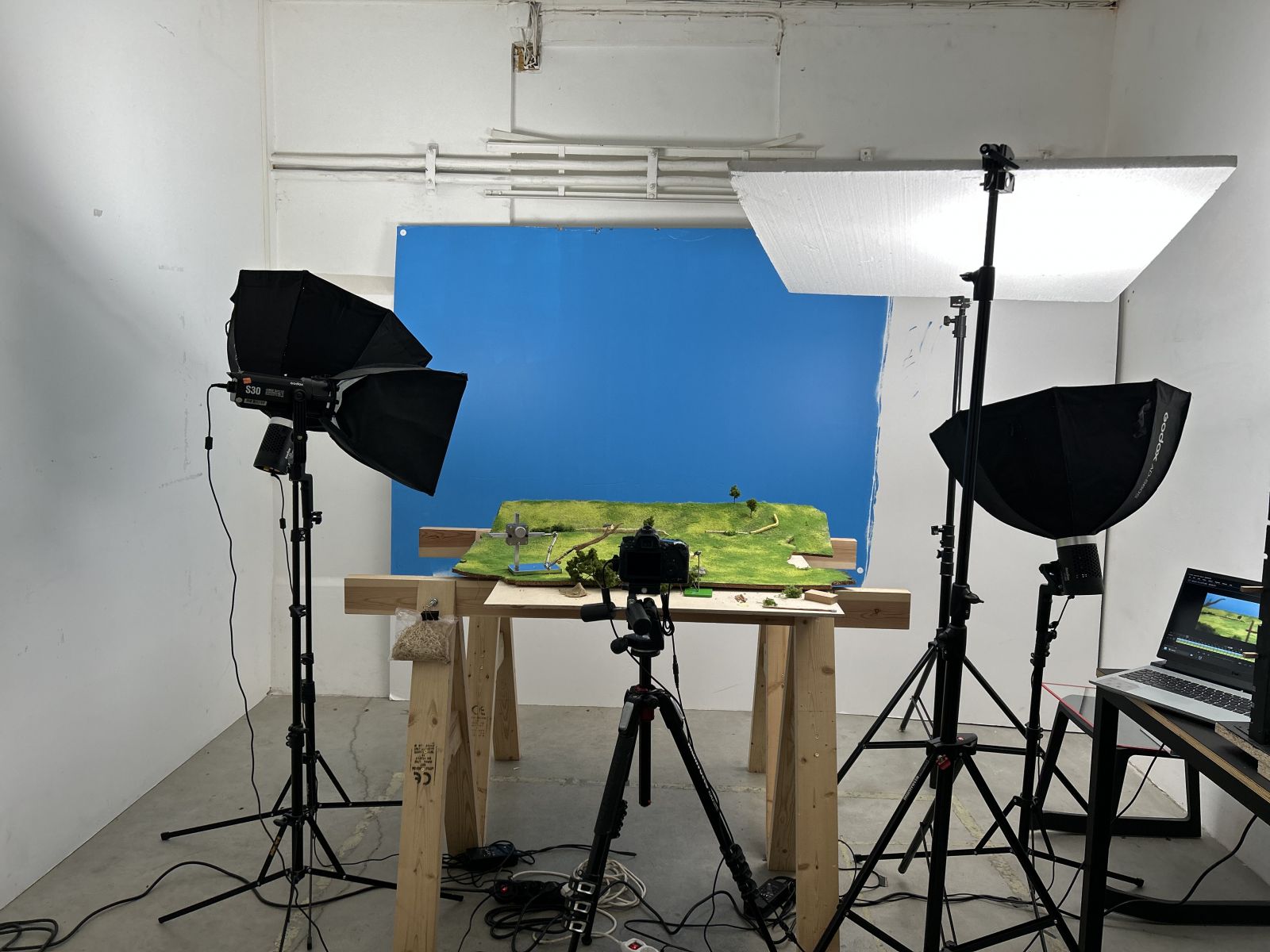
As in the case of Emma Sharp. In 1864, 31-year-old Emma undertook an athletic feat that might be called a challenge today: she set out to walk 1,000 miles in 1,000 hours. The challenge lay not only in the physical and mental endurance required for such an arduous task, but also – and perhaps primarily – in the obstacles placed before a female athlete by Victorian society and its system of values. Emma Sharp’s undertaking in the environs of Bradford, England, was one of the pioneering acts in women’s sports and drew significant media attention as well as public condemnation and very direct attempts at sabotage. A woman in male attire, in a male sport, confidently commanding a male-dominated public space – these were rules of a game that the Victorian social order neither knew nor had any desire to know. The scope of this game underpins Tactics of Contention– an installation of fragmentary elements that call for an almost forensic approach on the part of the viewer. In typical Lekše manner, the game we are trying to reconstruct intertwines different temporalities and different levels of “reality”; as a matter of fact, its central question is what reality really is and by whose rules it is construed.
But what working out the rules of a given game lays bare in Lekše’s case is how broadly applicable (such) rules are. Just as we feel that we have sufficiently mastered the rules of the game of a traditional, distant society, so that we would have been able to win it, we come to realize that surprisingly similar rules apply to the game of our own society. And that we are, in reality, nowhere near winning. The intertwining of fragments from different temporalities, levels of reality, and degrees of seriousness in Lekše’s work typically leads us to discover more than we had initially intended when deciphering the rules of a given game. We wanted to talk about something else, but ended up talking about ourselves. As we cheer on Emma Sharp on her emancipatory walk, we discover we are walking and stumbling along a similar path. In keeping with its athletic provenance, Tactics of Contention serve as a ground for assessing our own fitness and capacity for overcoming obstacles, and for asking (ourselves) which game we wish to play. And by whose rules.
Lene Lekše (1995, Ljubljana) received her master’s degree in 2021 from the Academy of Fine Arts and Design in Ljubljana, majoring in sculpture, mentored by prof. Jože Barši. She studied for a year at the Minerva Academy in Groningen (The Netherlands) as part of the Erasmus exchange. She is the recipient of two recognition awards from the Academy of Fine Arts and Design. Since 2018, she has been organizing student exhibitions in Slovenia as part of the pop-up project Gallery 7:069 together with Lara Reichmann, Mihael Novak, Nina Goropečnik and Maša Knapič. She is the recipient of the OHO Group Award 2021. She has participated in several solo and group exhibitions in Slovenia and abroad.