
Museum of Contemporary Art Zagreb (MSU Zagreb)
Curators: Jasna Jakšić, Kristjan Sedej
The exhibition Maja Bajević: A Short Histery of Our Times, opened at the Museum of Contemporary Art Metelkova (+MSUM) last year, will travel to the Museum of Contemporary Art Zagre (MSU Zagreb), where it will open on November 25 in the Black Box exhibition space. It presents recent works by internationally acclaimed artist Maja Bajević, an artist who has figured prominently on the art scene in the region of the former Yugoslavia since the 1990s. Her artistic practice is largely underpinned by the context of the wars in the former common state and by her native Bosnia and Herzegovina.
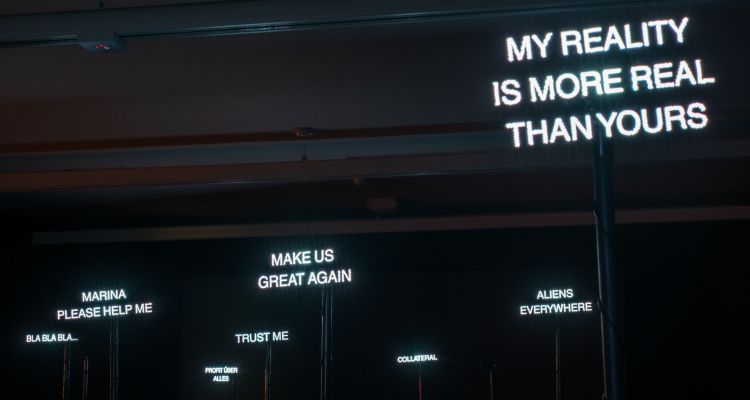
Most of the works on view were created specifically for the exhibition at +MSUM. Through them, Bajević explores the history of failed revolutionary movements that have brought Western society to its current state of collective impotence to shape a future, and to the pervasive social “hysteria”. The exhibition brings together reflections on the past, present, and future, critically examining historical amnesia and the conditions that enable the resurgence of radical ideologies and demagogic politics. Bajević considers the potential of forging new forms of collective struggle against exploitation and radicalism at a time when society is increasingly shaped by invisible structures of power, which draw individuals into their systems through empty slogans and corrupted symbols.
The travelling exhibition will mark Maja Bajević’s first solo exhibition in Croatia, where her work had previously been shown in group exhibitions and other events. The occasion marks an important opportunity to introduce the artist’s work to Croatian audiences and to further strengthen institutional ties across the region.
Maja Bajević, born in 1967 in Sarajevo, lives and works in Paris. Her multimedia oeuvre comprises a variety of practices that critically and cynically explore social and political themes marking contemporary social awareness and political power. Bajević critically deconstructs the role of women in society, globalization, political exploitation and exclusion, collective memory, and the consequences of neoliberalism. Her works include videos, installations, performances, drawings, and graphic prints. She has exhibited at the Museo Reina Sofía, MAXXI, Moderna Museet, MoMA PS1, and the 50th and 56th Venice Biennales, among other venues. Her works are included in the collections of many museums, including MACBA, Centre George Pompidou, National Gallery of Bosnia and Herzegovina, and Moderna galerija.
