Pavilion of the Republic of Slovenia
61st International Art Exhibition
La Biennale di Venezia
Commissioner: Martina Vovk (Moderna galerija Ljubljana)
Curator: Nataša Petrešin-Bachelez
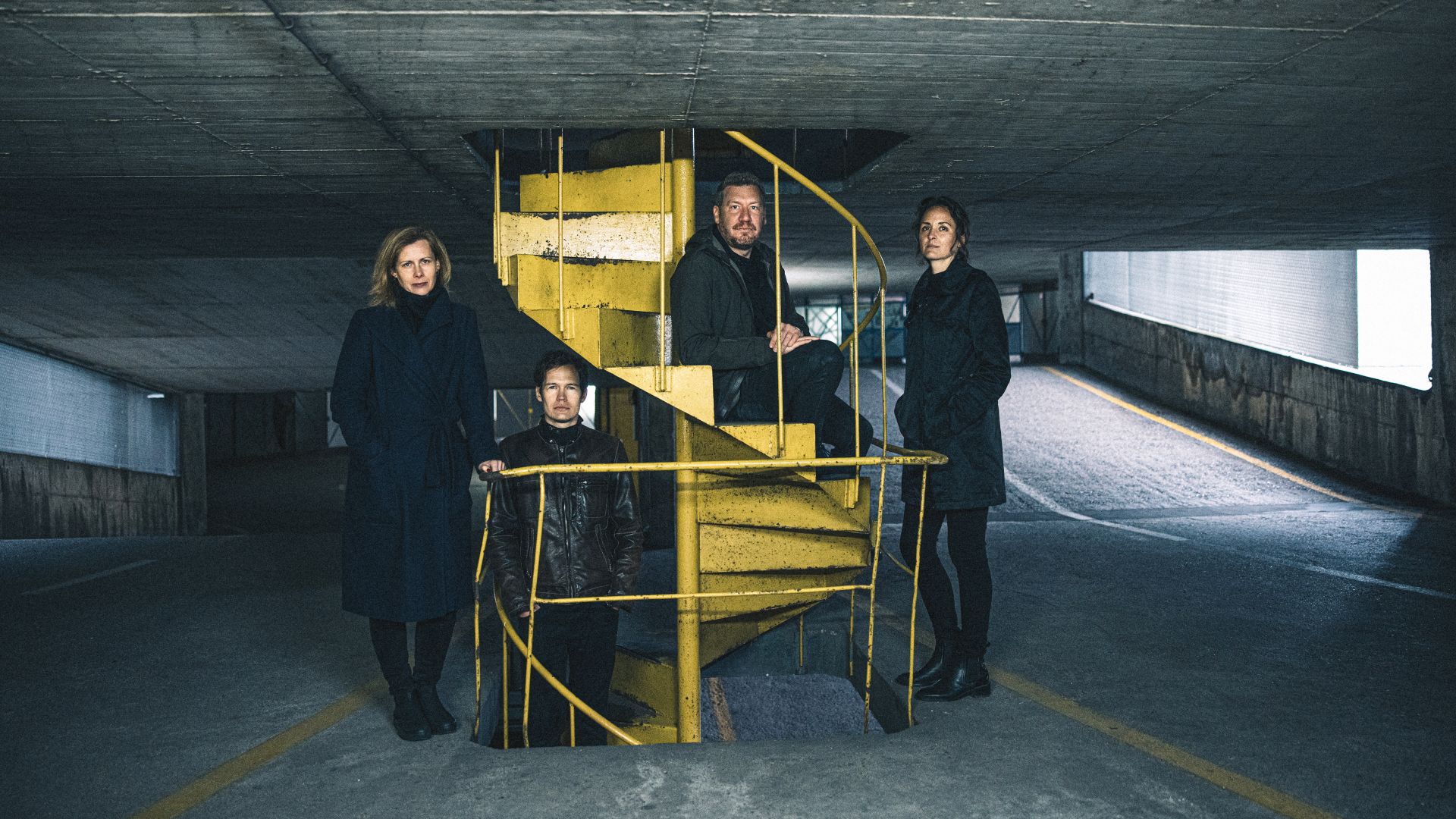
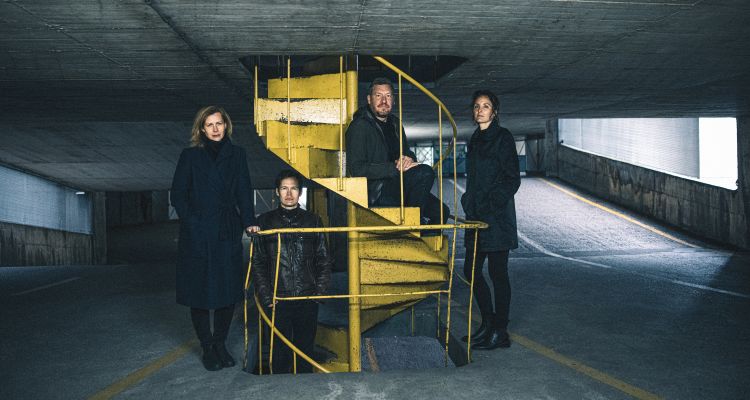
Exhibitors: NONUMENT GROUP (Neja Tomšič, Martin Bricelj Baraga, Nika Grabar, Miloš Kosec)
Scientific Advisor: Anja Zalta
Venue: Arsenale Exhibition Spaces, Venice
May 9 – November 22, 2026
About the Nonument Group and its research-led practice
The Nonument Group (Neja Tomšič, Martin Bricelj Baraga, Nika Grabar, and Miloš Kosec) is an art and research collective that focuses on nonuments: hidden, abandoned, erased or forgotten architecture and public spaces whose meaning has been transformed due to political or societal changes. The collective collaborates with institutions and independent researchers to map and archive nonuments around the world. With their art interventions, they explore memories and accentuate the tensions revealed by the reactivations of individual nonuments.
The Nonument Group has presented its work at Creative Time in New York; ISEA in Durban; the Dnipro Cultural Center; the Museum of Contemporary Art Metelkova (MSUM), the Museum of Architecture and Design (MAO), the 35th Ljubljana Biennale of Graphic Arts, the Historical Atrium of the Ljubljana Town Hall, and the U3 Triennial of Contemporary Slovenian Art in Ljubljana; the Koroška Gallery of Fine Arts; and the Cité internationale des arts in Paris, among other venues. In 2021, the group was awarded the Plečnik Medal for its contribution to the enrichment of architectural culture in Slovenia.
About the research project Soundtrack for an Invisible House
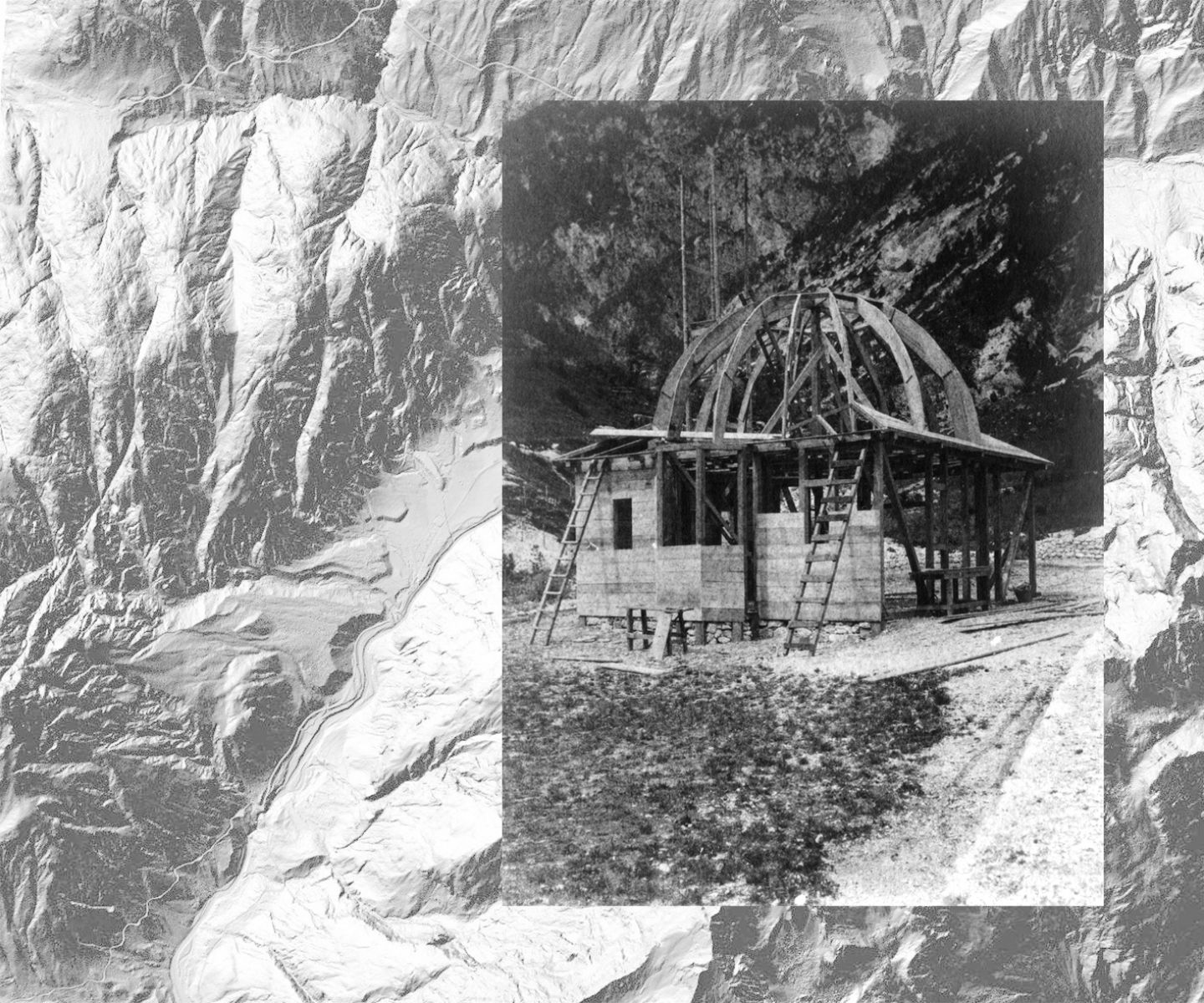
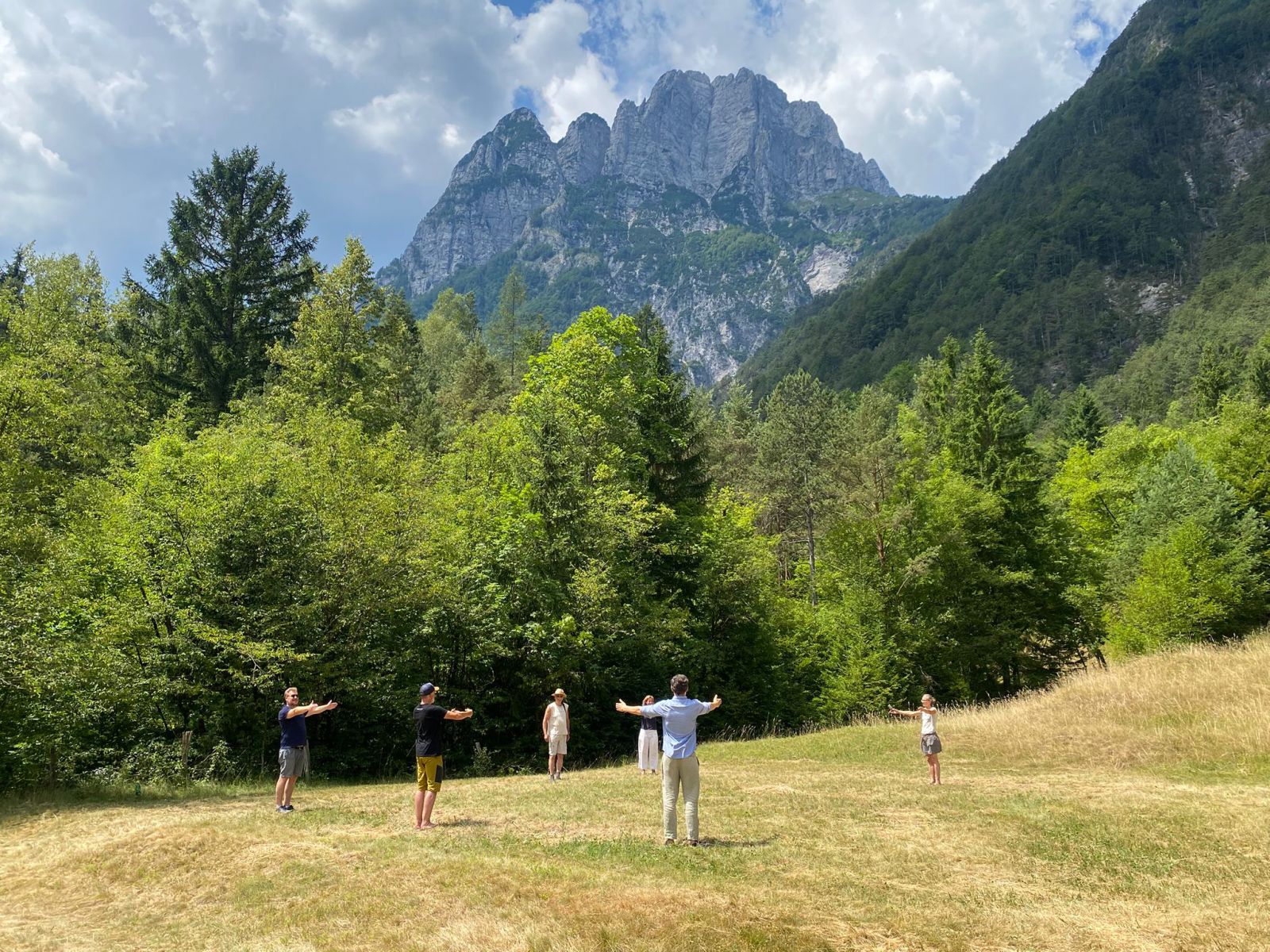
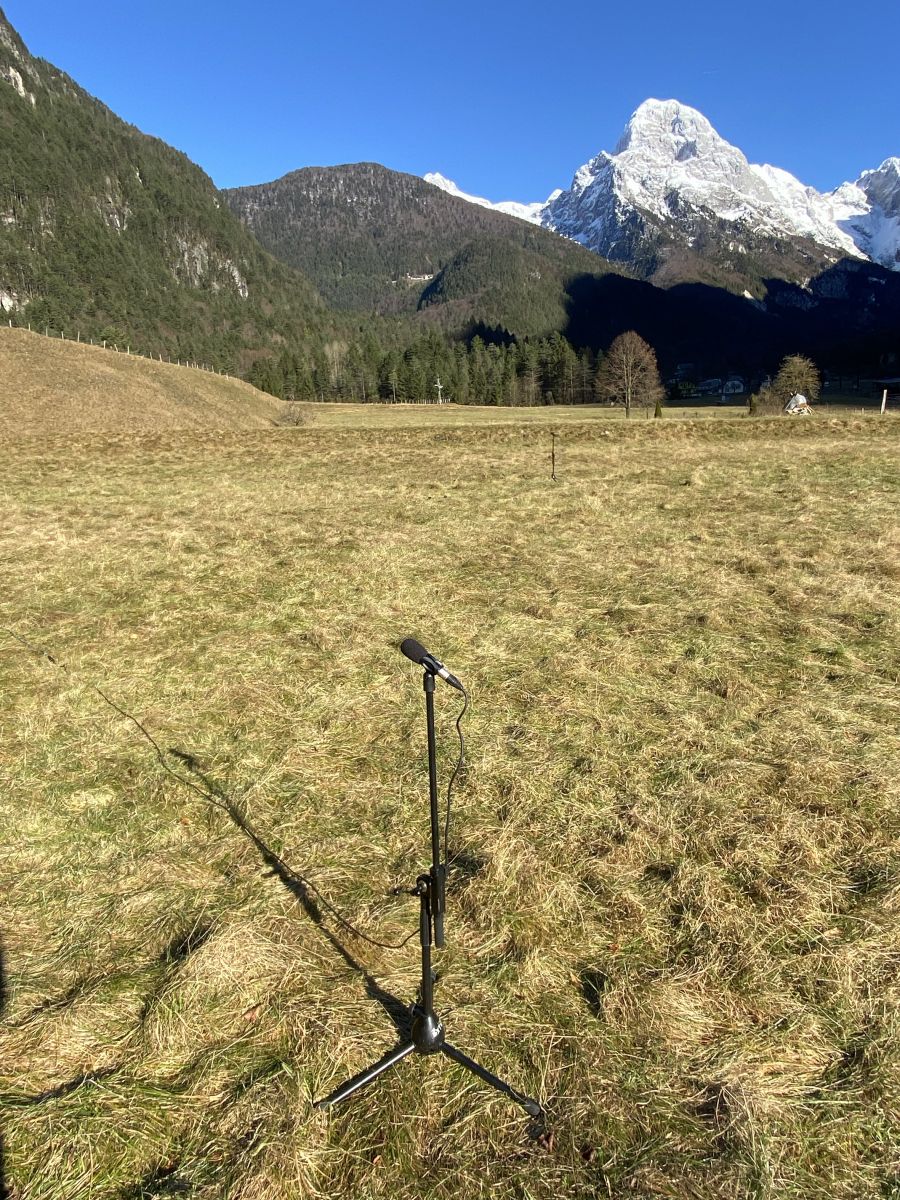
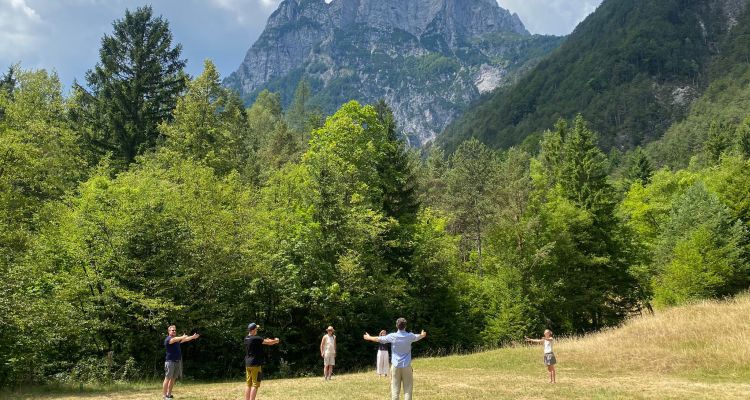
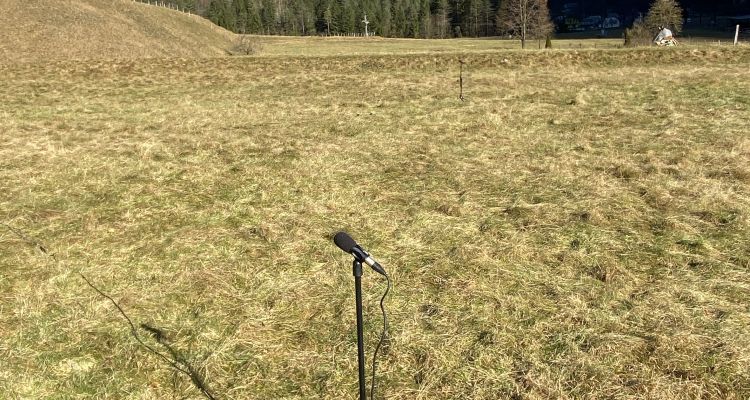
Nestled beneath the Alps near Slovenia’s northwestern border lies a small village of around 130 residents. A meadow stretches out behind one of the houses, framed by the mountain peaks of Jerebica, Mangart, Rombon, and others. Along the ridges of these mountains – rising over 2,000 meters – fierce battles were fought during World War I between Austro-Hungarian and Italian forces. In those days, this quiet patch of grass was the site of hundreds of military barracks. For a few months in 1917, a white-painted wooden mosque stood among them.
During the war, both military and colonial authorities systematically instrumentalized religion: they built mosques, churches, and chapels, and used religious rhetoric to strengthen the loyalty, morale, and discipline of soldiers. The mosque in Log pod Mangartom was built precisely in this context, and the Austro-Hungarian Empire erected it as part of its military infrastructure to strengthen the loyalty and integration of the Bosnian regiment into the otherwise predominantly Catholic army.
Built by the Austro-Hungarian Army in 1917, it fell into disrepair after the war and was likely destroyed during Italy’s 1920s annexation of the area. Until 2015, only six photographs, taken by villagers, remained as a record of its existence. The ruins of this, the first mosque on Slovenian territory, then part of the Austro-Hungarian Empire, were recently uncovered, and in 2022 additional archeological excavations took place, financed by the Islamic community of Slovenia, which revealed the stone-built base of the structure and several hundred artifacts underneath the meadow, such as metal objects, fragments of glass, animal bones, and pieces of wooden items. In November 2025, the Log pod Mangartom mosque was officially inscribed in the register of immovable cultural heritage of the Republic of Slovenia as a memorial site.
Several pieces of evidence – the use of temporary materials, an official opening that never took place and the construction timeline – indicate that the mosque was at least partly designed for propaganda purposes, similar to other mosques from the same time in Nogent-sur-Marne (France) and Halbmondlager (Germany), which served as demonstrations of the empire’s religious tolerance and as tools for mobilizing Muslim Arab, Indian and African soldiers. Such examples clearly show how religion – both in the past and today – is often instrumental in the service of war and politics.
For the Slovenian Pavilion at the Venice Biennale 2026, the Nonument Group presents the project Soundtrack for an Invisible House, curated by Nataša Petrešin-Bachelez, which is based on the ruins of the Log pod Mangartom mosque as a nonument. The project first raises the question of the instrumentalization of religion for political, economic, and territorial goals. In this, faith is used as a language of legitimization, a means of mobilizing soldiers and the population, and a tool for portraying the enemy as morally or spiritually illegitimate. Secondly, the project traces the mosque’s history and its meaning for today, bringing it into a conversation with the history of European Muslim identities in the 20th and 21st centuries, shaped by “religious idealism and social, political, economic and cultural constructions… passing through constant and unpredictable changes according to changing conditions in time and space,” as Prof. Anja Zalta, PhD, writes in her text “Muslim Identity in Times of Globalisation” (2006). However, the project not only deals with the story of Islam and Bosnian soldiers on the territory that was later to become Slovenia, but also opens a broader interpretation of the entanglements among power, spirituality, and wartime propaganda.
Soundtrack for an Invisible House addresses these layered meanings through an installation that invites stillness, functioning as both a shelter and amplifier. The pavilion builds its narrative in the form of a sound sculpture, with the audible narrative hovering over a seemingly “empty” space in the form of a platform resembling a ruin, created out of the material waste of the pavilions from the last Biennale of Architecture. The field of debris explores the nature of architecture transitioning to ruins, and in that process opening new and unexpected narratives, just as the invisible remnants of the World War I mosque in Log pod Mangartom became a catalyst for the new narratives of the 21st century. Today, much of the ruins of the mosque remain buried under an idyllic meadow. The pavilion uses this meadow as a symbol of the present moment and current wars – ones in which religion is once again being instrumentalized.
The pavilion’s appearance thus evokes an architectural frame of rest, contemplation, and listening. This seemingly empty landscape is inhabited and made alive through sounds – murmurs, whispers, fragments of songs, laughter, Alpine shepherds’ calls and voices – a recreated natural soundscape that outlines and attempts to articulate this place.
The Slovenian Pavilion is set within the Arsenale’s historic spaces, and thus the project also alludes to Venice’s centuries-long tradition of military and naval power. The two mirrors on the side walls of the pavilion create a mise en abyme of a landscape of ruins stretching into infinity. This visual illusion also makes reference to the Arsenale as a former military-industrial complex that today is an enfilade of exhibition rooms. Both the sound composition and the reflections in the mirrors aim to help the public feel immersed in the installation and observe how they have become an active part of it, and thus to engage with the questions posed by the project, rather than remain only distant observers.
Last but not least, the Slovenian Pavilion enters into a conversation with the main curatorial theme of the 61st Venice Biennale, In Minor Keys, as conceived by Koyo Kouoh, which invites us to slow down and listen to quieter, less celebrated stories.
About the Commissioner:
Martina Vovk, PhD, has been the Director of Moderna galerija in Ljubljana, the central national museum of modern and contemporary art in Slovenia, since 2024. She served as the Commissioner of the Slovenian Pavilion at the Biennale Arte 2024 in Venice.
About the Curator:
Nataša Petrešin-Bachelez is an interdependent curator, writer and editor, living and working in Paris. Together with Elena Sorokina and Magdi Masaraa, she is co-founder of the Initiative for practices and visions of radical care. Between 2021 and 2025 she was head of the arts and cultural programme at the Cité internationale des arts in Paris, between 2010 and 2012 she was co-director of Les Laboratoires d’Aubervilliers. She curated about fifty solo and group exhibitions, among them the Contour Biennale, Mechelen (2019) and the U3 –Triennial of Contemporary Art in Slovenia at the MSUM, Ljubljana (2013).
About the Scientific Advisor of the project:
Prof. Anja Zalta, PhD is Professor of Sociology of Religion at the Department of Sociology, Faculty of Arts, University of Ljubljana, and since 2024 the Head of the Center for Middle Eastern Studies at the Faculty of Arts.