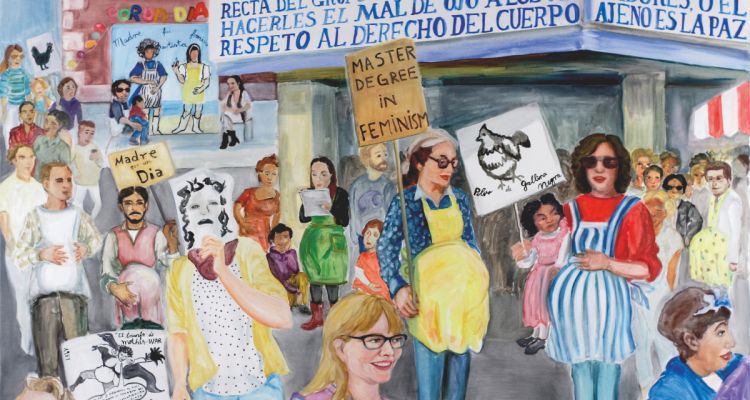
Lydia Hamann & Kaj Osteroth, Admiring Polvo de la Gallina negra, mistresses of feminist art, Oil on canvas, 115 x 160 cm, 2016 (cropped)
Curated by: Bettina Knaup, Iva Kovač and Mónica Mayer
With works by: Milijana Babić, selma banich, Laura Anderson Barbata, CADA, Graciela Carnevale, Ana Čigon, Diamela Eltit, Exterra XX, Else Gabriel, Regina José Galindo, Anna Bella Geiger, Lydia Hamann & Kaj Osteroth, María Teresa Hincapié, Ana Victoria Jiménez, Magali Lara, María Evelia Marmolejo, Mónica Mayer, Lorena Orozco, Giulia Palladini & Rodolfo Suárez Molnar, Polvo de Gallina Negra (Maris Bustamante & Mónica Mayer), Producciones y Milagros Agrupación Feminista (Rotmi Enciso & Ina Riaskov), Jesusa Rodríguez and Liliana Felipe, Maja Smrekar, Gabriele Stötzer, Cecilia Vicuña, Lorena Wolffer.
"For me, working with the archive is an act of self-defence against indifference, invisibilization, and the censorship caused by ignorance or by power." — Mónica Mayer
The exhibition Archival Chain Reactions emerges from a collaborative project dedicated to connecting and activating important yet precarious archives of feminist art. By addressing the historical erasure of women* and gender-nonconforming, queer feminist artists, this project aims to counter the threat of disappearing feminist archives and emphasises the necessity of networking and exchange among archives in different contexts globally. Rather than viewing archives solely as static repositories, Archival Chain Reactions highlights them as dynamic social formations that require continuous care, maintenance, and exchange.
The project brings together Pinto mi Raya (Mexico City), an archive built by the artists Mónica Mayer and Víctor Lerma, focusing on experimental art production and writing since the 1970s with a particular emphasis on performance and feminist artists; the project re.act.feminism (Berlin), which has been travelling as a living performance archive across Europe in several instalments since 2008; and City of Women (Ljubljana), with its significant, but dispersed archive accumulated over 31 years of festival and programme activities. None of these three archives are held by an institution or foundation with the sole purpose of keeping them. All are precarious – dependent on the support of individuals, without regular funding. Pinto mi Raya is an artists’ archive that has also been the source of artworks. re.act.feminism is a project that evolves in editions with halts and gaps, speculatively giving form to a living feminist performance archive in the making. City of Women is a curated series of events, accumulating a rich archive of its own traces and documents along the way. While they have contributed immensely to the development and promotion of feminist artistic practices in their respective contexts, as well as internationally, as precarious organisations their archives are fragile.
Nesting, Anchoring and Circulating
The exhibition has been developed through a mutual (non-exhaustive) investigation of the three archives, shifting between deep dives and bird’s-eye views. What has come into focus are some selected works and documents and a set of methods – distilled from the practices and specificities of each individual archive – which we have termed “archival chain reactions”: examining mutual relations, resonances and effects, overlaps or gaps, as well as considering how to affect (each) other's archiving practices along the way.
One example of an archival chain reaction is the strategy of hosting, or “nesting”, which impacts both the host and the hosted archive. During research curators discovered various nested archives – sets of documents that are fully or partially hosted in another archive. For instance, parts of the City of Women archive are held in the Temporary Slovenian Dance Archive. In the case of the Pinto mi Raya archive, it has at times included digital copies of the archives of other artists – temporarily, for safekeeping – like the archive of the photographer and activist Ana Victoria Jiménez, an important ally and companion of Mónica Mayer for several decades. Before donating the archive to an institution, this temporary form of storage was a safety net which guaranteed that her important artistic practice, together with her rich documentation of the Mexican feminist art scene since the 1970s, would not be lost.
Mónica Mayer's art project Archiva – which documents feminist art practices in Mexico and emerged in response to Ana Victoria Jiménez archive – is another archival initiative that, in the absence of institutional support for feminist art, has made the materials accessible to different audiences through a travelling series of lecture performances. By strategically presenting Archiva as a set of archival documents and donating them as such to several institutions, she playfully overcomes the barrier for the inclusion of feminist art in sanctioned art institutions. “Lubricating the system,” as Mayer describes it, or throwing an anchor as another modality of archival chain reaction. Developing multiple strategies of anchoring within networks, and at times within institutional contexts such as museums and universities – which is also the case with the inclusion of City of Women’s video archive within the MG+MSUM’s Network Museum – can allow for archives to be more accessible while also making them less precarious. Moreover, passing on an archive and putting it in the hands of others can be a strategy of shared ownership, which is exactly how the City of Women archive developed, thus growing based on the work of the many people and organisations who have invested in it. Such efforts make sure that the infrastructures which care for feminist art are maintained for the future: artists committing themselves to documenting feminist struggles, actions to enrich these struggles and make them more accessible, and feminist artists caring for the archives of their comrades.
Each encounter with an archive generates reverberations. re.act.feminism developed through an itinerant process of research, exhibition, and circulation which contributed to its growth and prompted further inquiries, collaborations, and performances. Along its journey across Europe, it was also presented at City of Women, while its very conception was to some extent inspired by one of its curators' earlier engagements with the festival. Similarly, Archiva – Mónica Mayer's archival project about feminist artists in Mexico – can be understood as an echo of Mayer's participation in re.act.feminism. Her encounter with this travelling archive – which included the works of Latin American performance artists she had never previously been able to see – deeply moved her and directly informed the development of Archiva. The curators therefore see this strategy of circulation as a generative force, setting off archival chain reactions.
Archives as a domicile. Archives on the road. Archives as a network
Since it is impossible to exhibit an archive, let alone three archives, it is important to clarify what this exhibition attempts: to show the dynamic among the three archives, as it developed in a year-long dialogue, and how ideas cross-pollinate and travel, as revealed through the cases of Pinto mi Raya, re.act.feminism, and City of Women. Central to this dynamic is Mónica Mayer’s extensive body of work, which introduces us to rich artistic practices and networks in Mexico and beyond, highlighting the early international feminist connections she helped establish, such as the Translations project, which reveals previously lesser-known connections between former Yugoslav and Mexican contexts.
Through selected documents, art works and methods from the three archives, we can observe archives as a home (as in Pinto mi Raya), as mobile devices (as in the case of re.act.feminism and Archiva), and as distributed in a network and across a city, as in the case of the City of Women’s archive, which is housed next door to the +MSUM, as well as with many different individuals, institutions, and organisations on the art scene in Ljubljana.
While switching from deep dives to bird's-eye views during our experimental non-academic approach to researching the three archives made a comprehensive overview difficult, it nevertheless allowed curators to learn from the many relations that constitute the fields of art and activism in their respective contexts. Creating a backbone for new relations to thrive.
Archivo Pinto mi Raya (Mexico City, 1975 onwards) is a personal and artistic archive built by the artists Mónica Mayer and Víctor Lerma. Their house has become the archive’s physical home, with parts donated to museums, libraries, and universities. It grew organically through personal documents, family materials, and books, and intentionally through conceptual art projects such as Raya: crítica, crónica y debate en las artes visuales and Archiva: obras del arte feminista en México, collecting and disseminating knowledge about feminist and contemporary art that institutions left unrecognised at the time. Its scope is wider than feminist art, but women artists and feminist practices are central to it.
re.act.feminism (Berlin, 2008 onwards) was initiated by the curators Bettina Knaup and Beatrice E. Stammer as an exhibition and archive project focusing on collective, activist, transdisciplinary, international performance art, and addressing the lack of accessible archives of this ephemeral medium. Although not an archive in the strict sense, the project has grown to become a temporary collection (on loan) of dispersed, otherwise inaccessible performance documents from more than 180 artists and collectives across some 40 countries, travelling through Europe. It grew with each iteration as hosting partners and advisors expanded the selection. What remains – between the times of its public presentation – are a website/digital archive, a book, research materials and DVDs and photo prints in filing cabinets and cellars, and archival traces in partner organisations across Europe, serving as a knowledge-production tool, and an aspiration for a living feminist performance archive.
City of Women (Ljubljana, 1995 onwards) was established as an interdisciplinary festival in the first years of the newly established Republic of Slovenia. Initiated by the governmental Office for Women's Policy, after its first edition the organisation was taken over by a precarious NGO that has since grown into a pioneering institution for feminist artistic and critical practice, featuring over 1,300 artists, theorists, and activists across festival editions and yearly programmes. Though not conceived as an archive, 31 years of programming have accumulated a unique body of documents, traces, and residues. These materials are dispersed across the organisation’s office, partner institutions, and collaborators, a fragmented record shaped in part by the changing artistic leadership, each director bringing in and leaving behind their own piece of the story. This body of knowledge constitutes a valuable resource, until now only partially accessible.
Credits:
Produced by: cross links e.V. Berlin & Association City of Women
Funded by: Visual Arts Project Fund of the Goethe-Institut; cross links e.V. Berlin; City of Women (Municipality of Ljubljana, Ministry of Culture of the Republic of Slovenia); and Culture Moves Europe, a project funded by the European Union
Made in collaboration with Association City of Women and Goethe-Institut Ljubljana.
This work was produced with the financial assistance of the European Union. The views expressed herein can in no way be taken to reflect the official opinion of the European Union.